
Delphi support for core outcome set development
Calibrum provides Surveylet software and optional Delphi study services for core outcome set development. For clinical trial research, use your own study team or commission support for stakeholder ratings, controlled feedback, consensus meeting preparation, and reporting.
Commission core outcome set Delphi support
Choose the work your team needs help delivering. Platform access, implementation support, methodology and questionnaire development, a final meeting, and a written report should be identified separately in the proposal.
Your team leads the study
Use Surveylet with your approved protocol and questionnaire. Add Complete Survey Care for configuration, testing, participant communications, and round operations within purchased hours.
Calibrum supports study delivery
Turn-key study services can cover Delphi planning, outcome wording, scales, feedback, setup, administration, and agreed analysis. Your investigators approve the scope, candidate outcomes, panel, and final decisions.
You need a meeting or report
Scope a facilitated consensus meeting and final analysis and report as required. Specify outcome-status tables, stakeholder comparisons, item revisions, and methods documentation.
For a proposal: send the condition and population, intended research use, candidate outcome list and its sources, stakeholder groups, anticipated panel size, round plan, deadline, and required deliverables. Identify who will lead recruitment, approve changes, and chair any final meeting.
Designed for outcome prioritization and stakeholder consensus
Stakeholder Group Management
Organize participants by stakeholder group, such as clinicians, researchers, patients, caregivers, policy leaders, or professional-society representatives.
Outcome Rating Scales
Use structured rating scales, such as 1–9 importance scales, agreement scales, feasibility scales, or custom rating frameworks.
Round-by-Round Feedback
Provide participants with group-level feedback, distribution summaries, and anonymized comments before they reconsider ratings.
Consensus Tracking
Monitor which outcomes meet inclusion, exclusion, or no-consensus thresholds based on predefined criteria.
Real-Time Delphi Options
Use real-time Delphi methods when the study design calls for faster iteration and participant access to updated group feedback.
Reporting-Ready Outputs
Export data and summaries for analysis, steering-committee review, consensus meetings, supplementary files, and manuscripts.
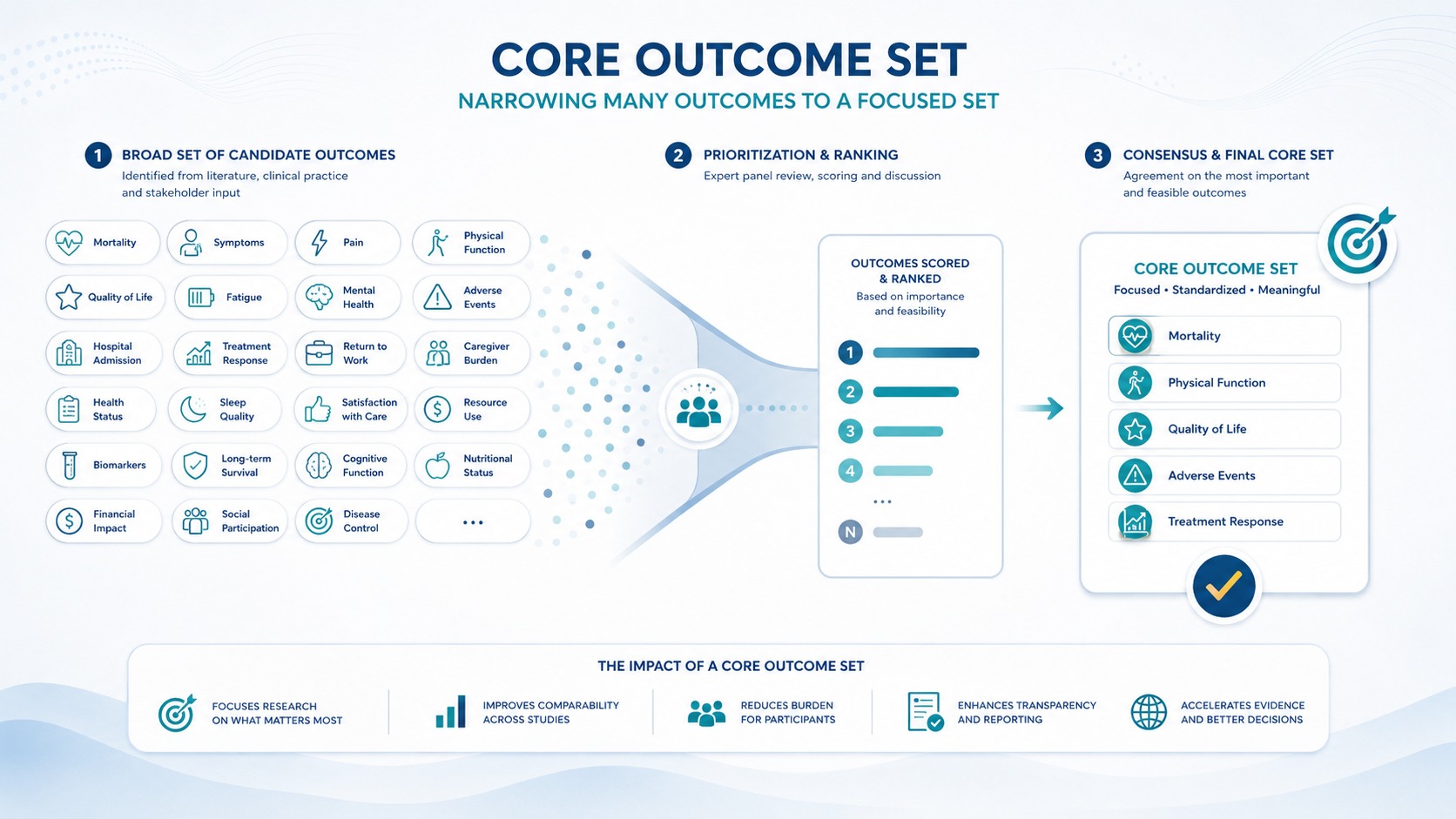
From long list to final core outcome set
Questions about core outcome set studies
Can patients and clinicians take part in the same study?
Yes. Surveylet can organize participants into stakeholder groups so your team can examine their ratings separately and together. Decide in advance which groups to include and whether consensus must be reached within each group.
Can Calibrum support the final consensus meeting?
A separately scoped Live Consensus Session can support independent outcome ratings, anonymized feedback, discussion, and reconsideration. The steering group defines how the meeting will resolve remaining items and confirm the final set.
Can a systematic review inform the Delphi study?
Yes. Your review can supply candidate outcomes for stakeholder prioritization. Agree on definitions and how review findings and stakeholder suggestions will enter the questionnaire. Commissioning Delphi support does not automatically include conducting the systematic review.
Do we need to develop a new core outcome set?
First check for an existing set that fits your condition, population, and intended use in the COMET database. A project using an existing COS has a different scope from developing a new one. Discuss the need with your methodology lead before commissioning a Delphi study.
Developing a core outcome set?
Calibrum can help you structure the Delphi process, configure Surveylet, support stakeholder participation, and prepare analysis-ready outputs for your steering committee, consensus meeting, or manuscript.