
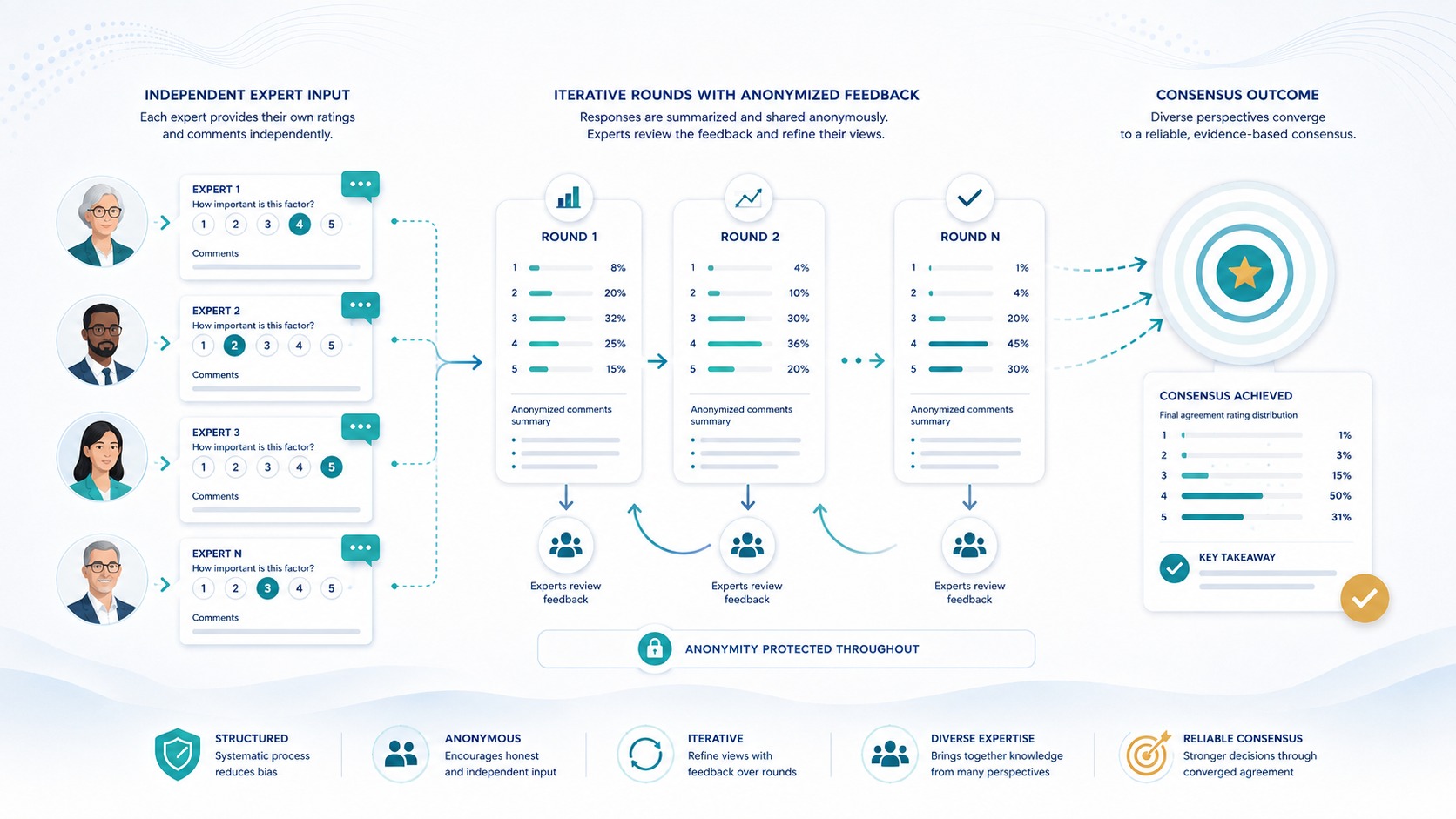
What Is the Delphi Method?
The Delphi method is a structured process for building consensus among experts or stakeholders through anonymous input, controlled feedback, and repeated rating or revision.

A structured way to turn expert judgment into consensus
Many important decisions cannot be answered by a single dataset, one expert, or an informal meeting. Clinical definitions, research priorities, quality indicators, care standards, and core outcome sets often require judgment from a diverse group of experts and stakeholders.
The Delphi method helps organize that judgment. Participants respond to structured questions, often rating the importance, feasibility, agreement, clarity, validity, priority, or appropriateness of each item. When more than one judgment matters, the dimensions should be rated and interpreted separately. After the first round, participants receive controlled feedback, such as group statistics and anonymized comments. They then have an opportunity to reconsider their responses in later rounds or during a real-time Delphi process.
The goal is not to force agreement. The goal is to make agreement, disagreement, uncertainty, and priorities visible in a transparent and repeatable way.
What makes Delphi different from a regular survey?
Anonymity
Participants can provide honest judgments without being influenced by hierarchy, reputation, seniority, or dominant voices.
Iteration
Participants can reconsider their responses after seeing structured feedback from the group.
Controlled Feedback
Feedback is organized through statistics, consensus indicators, and anonymized comments.
Defined Consensus Rules
The study team defines how consensus will be measured for each required rating dimension before interpreting the results.
Transparent Reporting
A well-run Delphi study documents the panel, rounds, response rates, rating scales, feedback, thresholds, item decisions, and stopping rules.
Stakeholder Inclusion
Modern Delphi studies often include clinicians, researchers, patients, caregivers, advocates, and other stakeholders.
Multi-round Delphi and real-time Delphi
Multi-Round Delphi
In a traditional multi-round Delphi study, participants complete a survey round, the study team analyzes the results, feedback is prepared, and a new round is launched.
- Core outcome set development
- Clinical guidelines and recommendations
- Formal research-priority setting
- Studies requiring steering-committee review between rounds
Real-Time Delphi
In a real-time Delphi study, participants can often see updated group feedback during the active survey period and revise their responses without waiting for a separate round.
- Time-sensitive consensus work
- Distributed expert panels
- Studies where rapid feedback is valuable
- Projects seeking to reduce multiple separate survey rounds
Common uses of Delphi in medical and health research
Core Outcome Sets
Determine which outcomes should be measured and reported in all studies of a condition, intervention, or population.
Clinical Definitions
Refine definitions and criteria where clinical practice varies or evidence is incomplete.
Practice Recommendations
Develop consensus recommendations, care pathways, or implementation guidance.
Research Priorities
Help funders, networks, and investigators prioritize unanswered research questions.
Quality Indicators
Identify measurable indicators of care quality, performance, or program effectiveness.
Patient and Stakeholder Consensus
Include patients, caregivers, advocates, administrators, and other stakeholders in structured decision-making.
How a Delphi study usually works
Why use Surveylet for Delphi?
Generic survey systems are usually designed for one-time data collection. Delphi studies require a more specialized workflow: participant tracking, structured feedback, revision across rounds, consensus indicators, and round-by-round analysis.
Surveylet was built specifically for Delphi and real-time Delphi studies. It helps teams manage the practical and methodological complexity of consensus research while keeping the participant experience clear and focused.
Plan and report the study transparently
A credible Delphi study explains not only what reached consensus, but how the panel was selected, who participated in each round, what feedback was returned, how items changed, and whether important stakeholder groups viewed the issues differently.
Design before launch
Predefine panel criteria, stakeholder groups, rating dimensions, consensus and disagreement rules, feedback, item decisions, and stopping logic.
Monitor representation
Track participation and attrition by round and assess whether the panel that completed the study still reflects the perspectives required by the research question.
Report more than a percentage
Document distributions, disagreement, qualitative reasoning, subgroup patterns, protocol changes, limitations, and unresolved items. Persistent polarization may represent two defensible positions—not a failed Delphi.
Not sure what kind of Delphi design you need?
Calibrum can help you choose between a multi-round Delphi, real-time Delphi, modified Delphi, hybrid process, or core outcome set workflow.
