
Surveylet features for Delphi, real-time Delphi, and live consensus sessions
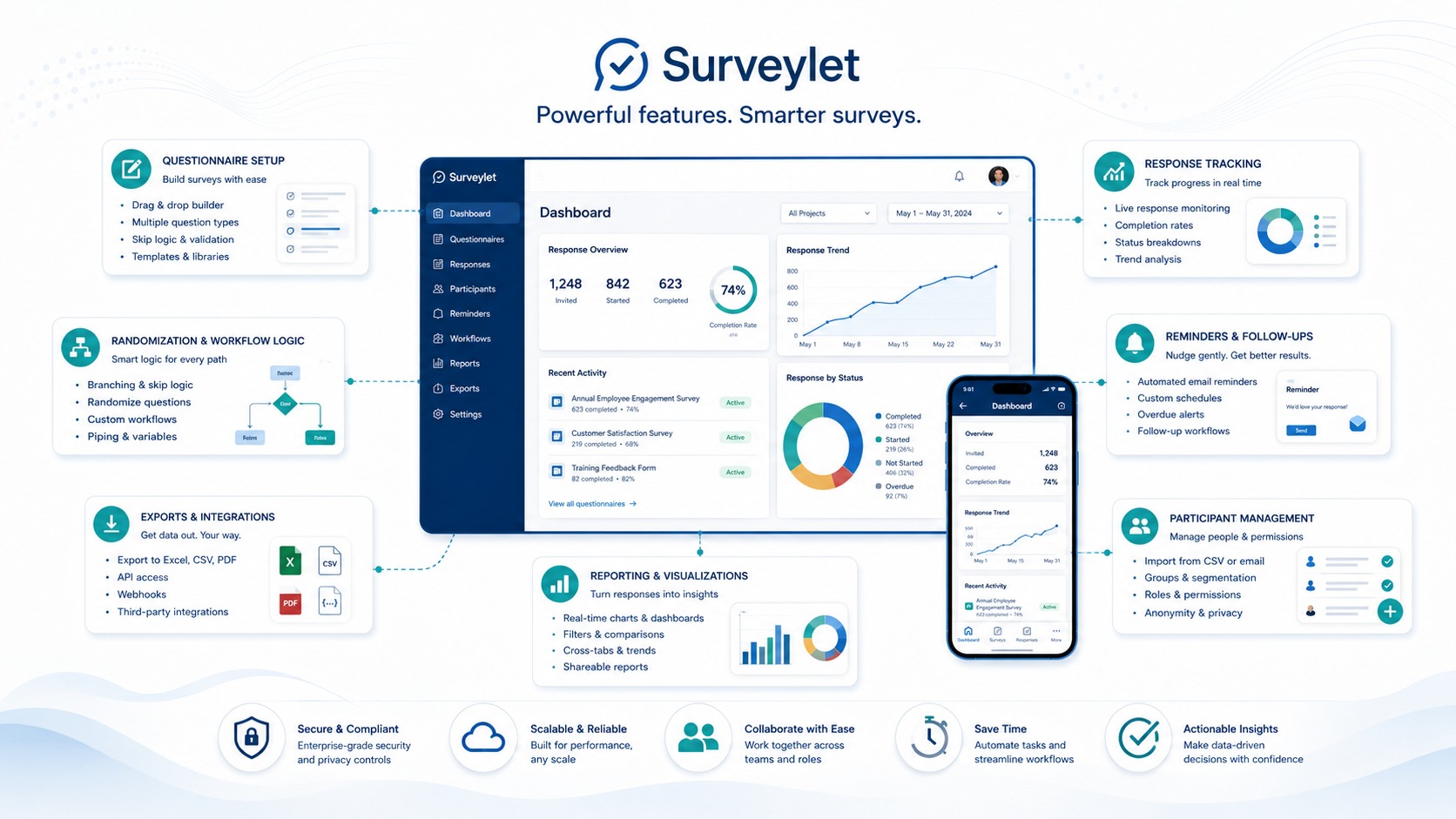
Surveylet is expert consensus software for multi-round Delphi, Real-Time Delphi, and core outcome set development. Use structured ratings, anonymized feedback, and response revision for research studies and live group decisions.
See how Surveylet supports Delphi studies
Watch a short overview of how Surveylet helps teams manage expert panels, structured feedback, rating rounds, real-time Delphi workflows, and consensus tracking.
The video is useful for teams that want to understand the platform experience before planning a multi-round Delphi, real-time Delphi, core outcome set, or medical consensus study.
Built around Delphi methodology
Generic survey software is usually designed for one-time questionnaires. Delphi studies require a specialized workflow: participant panels, anonymity, rating rounds, controlled feedback, response monitoring, consensus thresholds, item revision, and reporting across multiple stages.
Surveylet was designed to support that workflow directly, so research teams can focus on study design, expert input, and interpretation rather than forcing a Delphi process into a generic survey tool.
1. Delphi study design features
Surveylet supports the practical design elements needed for structured Delphi and consensus studies.
Multi-round Delphi support
Set up sequential Delphi rounds with controlled feedback and revised participant ratings.
Real-time Delphi support
Allow participants to review feedback and revise responses during an active survey window.
Modified Delphi workflows
Support customized processes that combine surveys, expert review, consensus meetings, and stakeholder feedback. See a published modified Delphi example using Surveylet.
Consensus rule planning and tracking
Support predefined inclusion, exclusion, agreement, disagreement, near-consensus, or unresolved rules matched to the study scale, rating dimension, and protocol.
Flexible rating scales
Use common 1–9 Likert-style scales or other structured numeric and categorical scales suited to importance, feasibility, agreement, priority, validity, or appropriateness.
Multiple rating dimensions
Ask panelists to evaluate separate constructs—such as importance and clarity, or validity and feasibility—without collapsing distinct judgments into one score.
Item carry-forward
Carry items forward across rounds based on dimension-specific consensus status, steering-committee review, or study rules.
Protocol-guided rounds
Structure rounds so the study team can apply predefined continuation or stopping rules and document why another round is—or is not—needed.
2. Participant and panel management
Delphi studies depend on the right participants, clear access, response tracking, and anonymous input. Surveylet helps teams manage the panel workflow throughout the study.
Invite-only participant access
Control who participates in the study and help ensure that responses come from the intended expert or stakeholder panel.
Expert panel management
Organize participants for clinician, researcher, patient, caregiver, administrator, or professional-society panels and monitor who actually participates in each round.
Stakeholder-group segmentation
Define relevant stakeholder groups, monitor representation and attrition, and identify overall consensus that may conceal important group-specific differences.
Anonymous participation
Reduce dominance effects, hierarchy pressure, and groupthink by collecting structured input anonymously.
Response tracking
Monitor who has completed each round and identify where reminders or follow-up may be needed.
Custom instructions and consent pages
Add study-specific instructions, consent text, eligibility logic, and participant-facing guidance.
3. Feedback between rounds
Structured feedback is one of the most important differences between a Delphi study and a regular survey. Surveylet helps teams provide participants with useful information before they reconsider ratings.
Controlled quantitative feedback
- Group response summaries
- Rating distributions
- Consensus indicators
- Prior-round comparison
- Stakeholder-group summaries when applicable
Controlled qualitative feedback
- Anonymized participant comments
- Rationale for agreement or disagreement
- Suggested item wording changes
- Missing-item suggestions
- Feedback for steering-committee review
4. Real-time Delphi capabilities
Real-Time Delphi allows participants to review controlled group feedback and revise responses during an active survey window. The same workflow can support time-limited conference and meeting sessions when a group needs structured input, rapid reflection, and a documented decision.
Faster iteration
Reduce the waiting time between separate survey rounds when the study design supports real-time feedback.
Participant reflection
Allow panelists to reconsider ratings after reviewing group-level feedback.
Modern consensus workflow
Support distributed expert panels that need structured feedback without unnecessary delay.
Live conference delivery
Support scheduled, facilitator-led sessions in which participants respond from their own phones, tablets, or computers.
Anonymized group input
Help participants express disagreement or alternative views without requiring a public challenge to a colleague, leader, or senior expert.
Immediate result monitoring
Track participation, response distributions, comments, consensus indicators, and unresolved disagreement while the session is underway.
Live consensus for conferences, workshops, and meetings
Large-group discussion can be slow and can favor the people who speak first, most often, or with the greatest authority. Surveylet Live Consensus Sessions give each participant an independent voice and provide structured group feedback before a final or revised response is collected.
Independent input
Participants evaluate statements, options, priorities, or recommendations before group dynamics influence their response.
Shared feedback
The group can review anonymized response distributions, consensus indicators, and comments without identifying individual participants.
Structured reconsideration
Participants can reconsider their position after seeing the group’s feedback, helping the meeting identify convergence and genuine disagreement.
5. Medical and core outcome set support
Surveylet is especially useful for medical Delphi, public health consensus, and core outcome set projects where multiple stakeholder groups need to evaluate long lists of outcomes, statements, criteria, or recommendations.
Core outcome set surveys
Prioritize candidate outcomes using structured rating scales and consensus thresholds.
Core data set projects
Support consensus around minimum data elements, domains, and reporting requirements.
Medical stakeholder panels
Include clinicians, researchers, patients, caregivers, professional societies, and policy stakeholders.
Outcome-domain organization
Organize large item lists into domains, categories, sections, and structured rating pages.
Consensus meeting preparation
Prepare outputs for steering committees, advisory boards, or final consensus meetings.
Publication-support exports
Export results for manuscript tables, figures, appendices, anonymized supporting files, and other supplementary materials.
6. Reporting and exports
Investigators need more than raw survey responses. They need clear outputs for steering committees, funders, consensus meetings, and manuscripts. Surveylet helps organize the data needed for reporting and interpretation.
Response exports
Export participant responses for analysis, archiving, and study documentation.
Round-by-round summaries
Summarize results across each round of a traditional Delphi study.
Consensus and disagreement profiles
Identify items that reached consensus, failed a required rating dimension, remained unresolved, or show stable polarization that should be preserved rather than averaged away.
Comment exports
Review and categorize qualitative comments, suggestions, and participant rationale.
Stakeholder comparisons
Compare response patterns by participant group when the protocol requires subgroup review, including overall consensus with subgroup differences, while retaining denominators and avoiding overinterpretation of small groups.
Manuscript-ready support
Use outputs to develop methods sections, supplementary tables, consensus-meeting materials, and a transparent record of item, rule, and round decisions.
Typical Delphi workflow in Surveylet
Best-fit use cases
Core Outcome Sets
Outcome prioritization and consensus across stakeholder groups.
Clinical Recommendations
Consensus on guidance, standards, pathways, or best practices.
Research Priorities
Ranking unanswered questions, evidence gaps, and funding priorities.
Quality Indicators
Defining measures of care quality, performance, or program success.
Definitions and Criteria
Consensus on clinical definitions, diagnostic criteria, and terminology.
Patient-Centered Research
Structured input from patients, caregivers, and advocacy communities.
Professional Societies
Expert panels, guideline groups, and consensus committees.
Public Health
Consensus across disciplines, agencies, regions, or stakeholder groups.
Conference and Meeting Decisions
Structured, anonymized decision-making for conferences, workshops, advisory boards, committees, and leadership groups.
Advanced randomization and study-design controls
Some consensus and research surveys require more than a fixed questionnaire order. Surveylet can support advanced randomization approaches to reduce order effects, balance exposure across survey sections, and support structured allocation of participants or items.
Page sequence randomization
Surveylet can randomize the sequence of selected pages or survey sections. This can help distribute fatigue effects more evenly when participants are asked to evaluate multiple models, domains, statements, or item groups.
Balanced exposure across sections
When long surveys risk participant fatigue, page-sequence randomization can help avoid systematically advantaging or disadvantaging items that always appear early or late in the survey.
Stratified randomization
Surveylet can support stratified randomization approaches where participants are allocated within defined groups or strata, helping maintain balance across important participant characteristics or study conditions.
Stratified block permutation
For studies that require controlled allocation, Surveylet can support stratified block permutation methods to help balance assignment across strata while preserving randomization within blocks.
Reduced order bias
Randomization can reduce the risk that results are driven by page order, item order, fatigue, learning effects, or repeated exposure to similar content.
Custom research workflows
Calibrum can configure custom randomization workflows for Delphi, real-time Delphi, core outcome set, comparative rating, and specialized research surveys.
RAND/UCLA Appropriateness Method support
Surveylet can support RAND/UCLA Appropriateness Method studies, including 1–9 appropriateness ratings, expert-panel workflows, structured feedback, comments, and analysis-ready exports for classifying clinical scenarios as appropriate, uncertain, or inappropriate.
Learn About RAND/UCLA SupportWant Calibrum to help run the study?
Surveylet can be licensed as a platform, but Calibrum can also support the full Delphi workflow through turn-key Delphi study services. This can include methodology planning, questionnaire design, Surveylet setup, participant communications, round management, analysis, and reporting support.
Planning a Delphi study or a live consensus session?
Review the Delphi Study Design and Reporting Checklist before launch to address panel composition, representation, consensus rules, feedback, attrition, analysis, and reporting decisions.
Calibrum can provide Surveylet as a specialized platform, help run a complete Delphi study, or plan and support a structured Real-Time Delphi decision-making session during your conference or meeting.